Key takeaways
Key takeaways
Crypto charts display open-high-low-close (OHLC) data.
Crypto charts display open-high-low-close (OHLC) data.
OHLC data helps traders track price movements, analyze volatility and identify trading opportunities.
OHLC data helps traders track price movements, analyze volatility and identify trading opportunities.
The X-axis represents timeframes, while the Y-axis shows price levels, either on a linear or logarithmic scale. Volume bars below the chart help confirm market participation.
The X-axis represents timeframes, while the Y-axis shows price levels, either on a linear or logarithmic scale. Volume bars below the chart help confirm market participation.
Candlestick charts remain the most popular for their detail, while line charts offer quick overviews, and bar charts provide an alternative OHLC breakdown.
Candlestick charts remain the most popular for their detail, while line charts offer quick overviews, and bar charts provide an alternative OHLC breakdown.
Common patterns such as head and shoulders, double tops and bottoms, triangles, flags, pennants and wedges capture trader sentiment and help forecast potential reversals or continuations.
Common patterns such as head and shoulders, double tops and bottoms, triangles, flags, pennants and wedges capture trader sentiment and help forecast potential reversals or continuations.
In 2025, crypto remains a mix of opportunity and challenge. Prices continue to fluctuate as fresh regulations, new tech and AI trends influence how the market moves.
In 2025, crypto remains a mix of opportunity and challenge. Prices continue to fluctuate as fresh regulations, new tech and AI trends influence how the market moves.
For beginners, the market can feel overwhelming, but once you learn how to read crypto charts, the chaos starts to make sense.
For beginners, the market can feel overwhelming, but once you learn how to read crypto charts, the chaos starts to make sense.
This article explains how to read crypto charts by breaking down essential patterns, tools and techniques. Whether you’re trying to anticipate Bitcoin’s (BTC) next move or explore upcoming altcoin rallies, you’ll gain practical skills to interpret price action. With a clear, step-by-step approach, it helps you build a solid foundation for crypto trading and avoid common mistakes.
This article explains how to read crypto charts by breaking down essential patterns, tools and techniques. Whether you’re trying to anticipate Bitcoin’s (BTC) next move or explore upcoming altcoin rallies, you’ll gain practical skills to interpret price action. With a clear, step-by-step approach, it helps you build a solid foundation for crypto trading and avoid common mistakes.
Crypto chart fundamentals
Crypto chart fundamentals
Crypto price charts visually represent price movements across different timeframes, providing insights into trends, volatility and trading opportunities. In a fast-paced crypto market, open-high-low-close (OHLC) data enables investors to track price changes within specific periods, forming the core of technical analysis.
Crypto price charts visually represent price movements across different timeframes, providing insights into trends, volatility and trading opportunities. In a fast-paced crypto market, open-high-low-close (OHLC) data enables investors to track price changes within specific periods, forming the core of technical analysis.
Key components
Key components
Understanding the structure of crypto charts is essential for traders. Main components of crypto charts include:
Understanding the structure of crypto charts is essential for traders. Main components of crypto charts include:
X-axis: Multi-timeframe analysis is key to balancing short-term trades with a long-term outlook. You can adjust charts from one-minute to monthly intervals.
X-axis: Multi-timeframe analysis is key to balancing short-term trades with a long-term outlook. You can adjust charts from one-minute to monthly intervals.
Y-axis: The price scale can be set to linear or logarithmic. A logarithmic scale is more useful for long-term crypto analysis because it highlights percentage-based changes more clearly.
Y-axis: The price scale can be set to linear or logarithmic. A logarithmic scale is more useful for long-term crypto analysis because it highlights percentage-based changes more clearly.
Volume bars: These show market activity and help confirm chart patterns by indicating whether a breakout or reversal is backed by strong trading participation.
Volume bars: These show market activity and help confirm chart patterns by indicating whether a breakout or reversal is backed by strong trading participation.
Foundational chart types
Foundational chart types
Some chart types form the foundation of technical analysis. The most common ones include:
Some chart types form the foundation of technical analysis. The most common ones include:
Candlestick: The most widely used chart type, showing OHLC data within a single bar.
Candlestick: The most widely used chart type, showing OHLC data within a single bar.
Line: Offers a quick view of overall trends by connecting closing prices over time.
Line: Offers a quick view of overall trends by connecting closing prices over time.
Bar: An alternative to candlesticks that also displays the OHLC structure in a simpler format.
Bar: An alternative to candlesticks that also displays the OHLC structure in a simpler format.
With the rise of AI, charts that integrate onchain data, such as wallet activity and total value locked (TVL), are becoming increasingly popular. These advanced charts give traders deeper insights into evolving market dynamics.
With the rise of AI, charts that integrate onchain data, such as wallet activity and total value locked (TVL), are becoming increasingly popular. These advanced charts give traders deeper insights into evolving market dynamics.
Did you know? Candlestick charts originated in 18th-century Japan, where they were first used to track rice trading, long before making their way into modern crypto markets.
Did you know? Candlestick charts originated in 18th-century Japan, where they were first used to track rice trading, long before making their way into modern crypto markets.
Five most popular chart patterns in crypto trading
Five most popular chart patterns in crypto trading
Chart patterns are shapes formed by price movements that help traders anticipate future market trends. These patterns fall into two main categories: reversal patterns, which signal that a current trend may change direction, and continuation patterns, which suggest the trend will likely resume after a brief pause. They stem from market psychology, where emotions like fear, greed and uncertainty drive collective trading behavior and create recognizable shapes on charts.
Chart patterns are shapes formed by price movements that help traders anticipate future market trends. These patterns fall into two main categories: reversal patterns, which signal that a current trend may change direction, and continuation patterns, which suggest the trend will likely resume after a brief pause. They stem from market psychology, where emotions like fear, greed and uncertainty drive collective trading behavior and create recognizable shapes on charts.
Here are five common patterns every crypto investor, including beginners, should know:
Here are five common patterns every crypto investor, including beginners, should know:
1. Head and shoulders
1. Head and shoulders
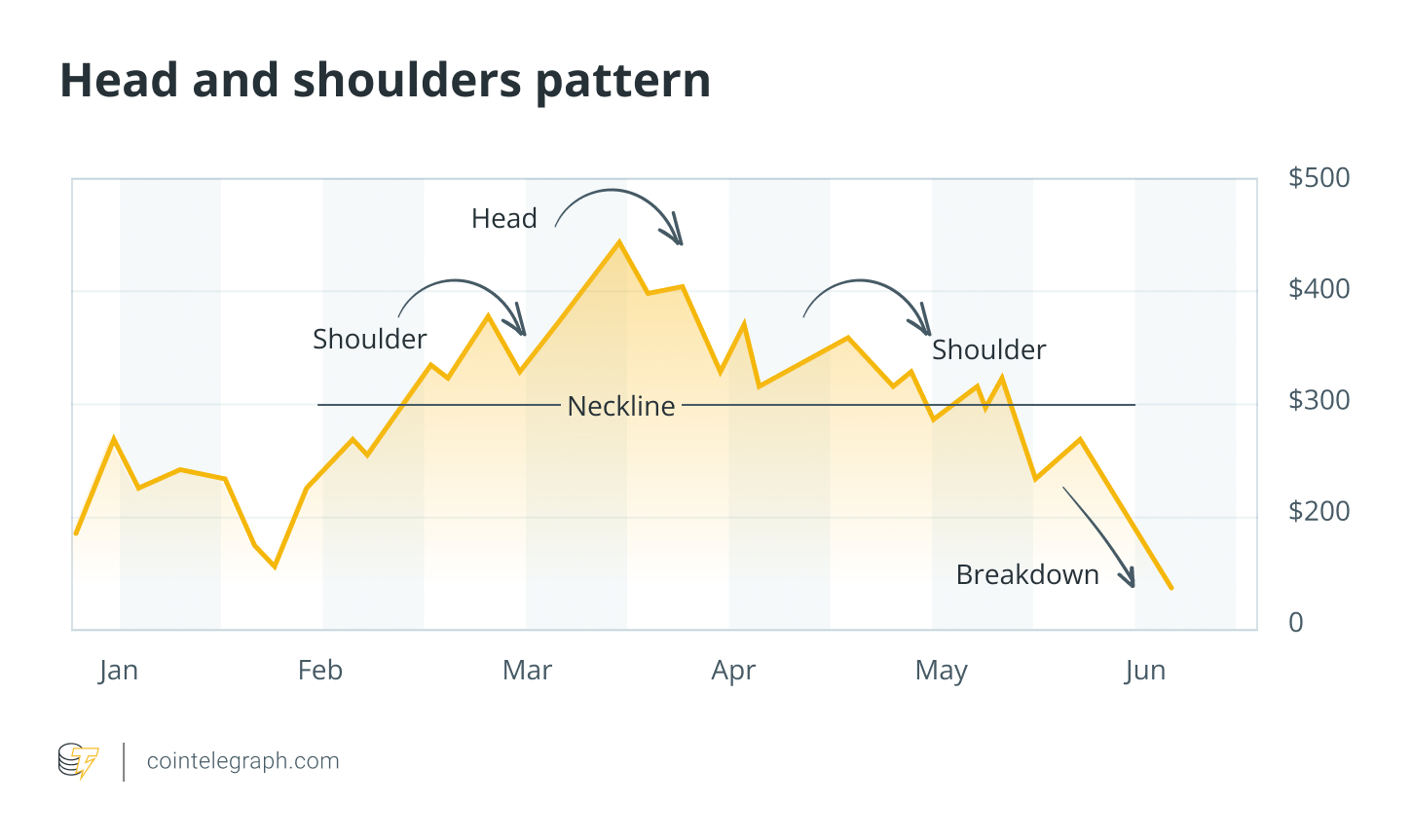
The head-and-shoulders pattern features three peaks, with a higher middle peak (the head) between two smaller ones (the shoulders), all connected by a “neckline.” The inverse version indicates a potential bullish reversal.
The head-and-shoulders pattern features three peaks, with a higher middle peak (the head) between two smaller ones (the shoulders), all connected by a “neckline.” The inverse version indicates a potential bullish reversal.
How to read: A decline in volume on the right shoulder signals weakening momentum. A price break below the neckline confirms a bearish reversal, while a break above it confirms a bullish inverse. Measure the distance from the head to the neckline, then project that distance from the breakout point to estimate the target move.
How to read: A decline in volume on the right shoulder signals weakening momentum. A price break below the neckline confirms a bearish reversal, while a break above it confirms a bullish inverse. Measure the distance from the head to the neckline, then project that distance from the breakout point to estimate the target move.
Stop-loss: Place it above the right shoulder for bearish setups or below it for bullish ones.
Stop-loss: Place it above the right shoulder for bearish setups or below it for bullish ones.
Example: This pattern often appears during altcoin corrections after major hype cycles, such as following a token’s listing on a major exchange like Binance. In early 2025, Cardano (ADA) formed a head-and-shoulders pattern during a correction phase after its governance upgrade buzz, signaling a temporary bearish move.
Example: This pattern often appears during altcoin corrections after major hype cycles, such as following a token’s listing on a major exchange like Binance. In early 2025, Cardano (ADA) formed a head-and-shoulders pattern during a correction phase after its governance upgrade buzz, signaling a temporary bearish move.
2. Double top and double bottom
2. Double top and double bottom
Double tops form an “M” shape near resistance, signaling a potential bearish reversal. Double bottoms form a “W” shape near support, signaling a potential bullish reversal.
Double tops form an “M” shape near resistance, signaling a potential bearish reversal. Double bottoms form a “W” shape near support, signaling a potential bullish reversal.
How to read: These patterns show two failed attempts to break resistance (top) or support (bottom). Confirmation occurs when the price crosses the neckline: bearish for double tops and bullish for double bottoms. Measure the height from the neckline to the peaks or troughs, then project it from the breakout point to estimate the move.
How to read: These patterns show two failed attempts to break resistance (top) or support (bottom). Confirmation occurs when the price crosses the neckline: bearish for double tops and bullish for double bottoms. Measure the height from the neckline to the peaks or troughs, then project it from the breakout point to estimate the move.
Stop-loss: Place it above the top peaks or below the bottom troughs.
Stop-loss: Place it above the top peaks or below the bottom troughs.
Example: This pattern often appears in memecoin pump-and-dumps. For instance, Dogecoin (DOGE) formed a double top in mid-2025 after a social media-driven surge, followed by a sharp correction.
Example: This pattern often appears in memecoin pump-and-dumps. For instance, Dogecoin (DOGE) formed a double top in mid-2025 after a social media-driven surge, followed by a sharp correction.

3. Triangle
3. Triangle
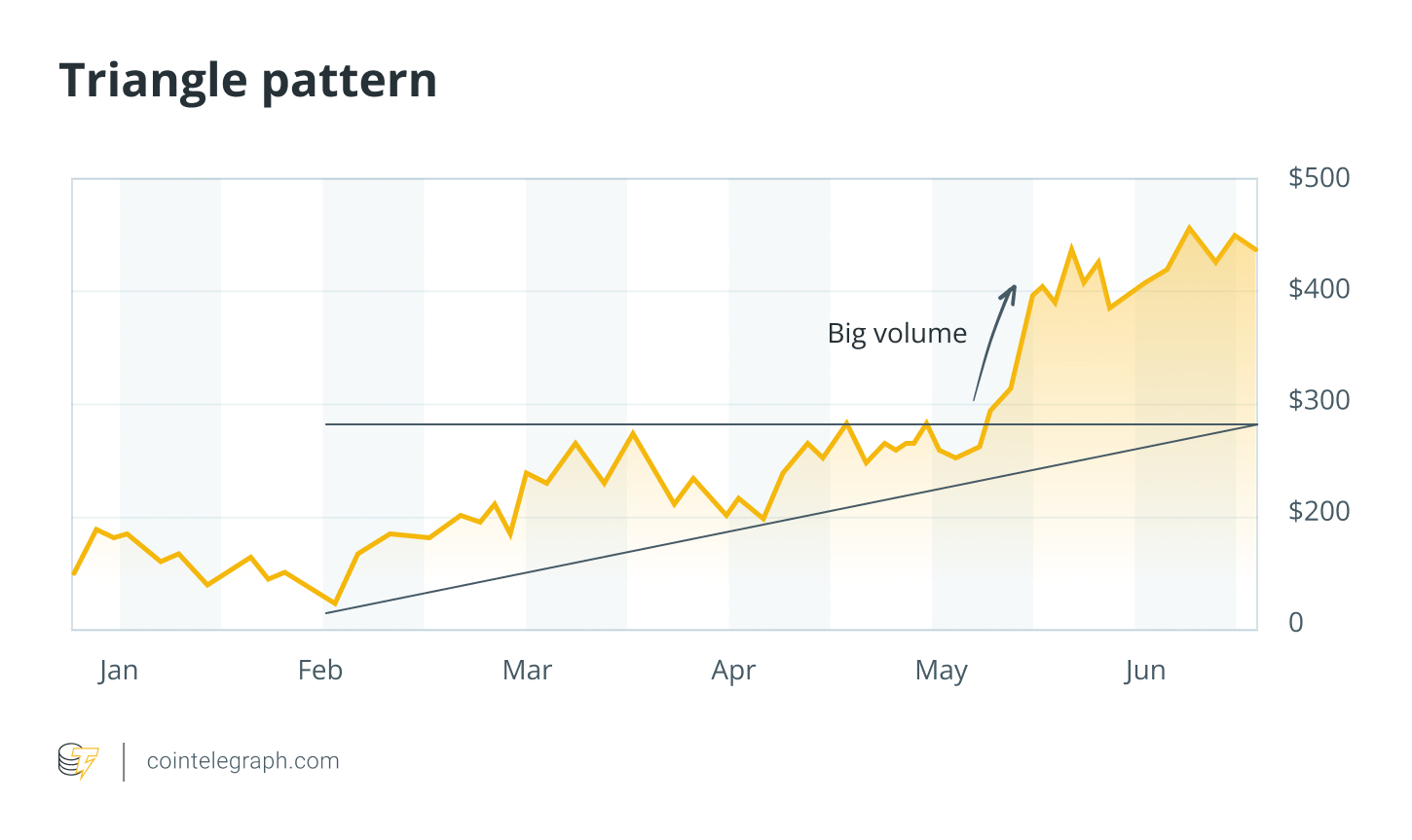
Triangle patterns form when price movements create converging trendlines, resulting in a triangular shape. The three main types are ascending (bullish), descending (bearish) and symmetrical (neutral).
Triangle patterns form when price movements create converging trendlines, resulting in a triangular shape. The three main types are ascending (bullish), descending (bearish) and symmetrical (neutral).
How to read: Breakouts often follow the existing trend but can occasionally reverse it. Estimate the price target by measuring the base width of the triangle and projecting it from the breakout point. A breakout upward in an uptrend is typically bullish, while a breakdown in a downtrend is bearish. To avoid false signals, use a 1%-2% filter before confirming a move.
How to read: Breakouts often follow the existing trend but can occasionally reverse it. Estimate the price target by measuring the base width of the triangle and projecting it from the breakout point. A breakout upward in an uptrend is typically bullish, while a breakdown in a downtrend is bearish. To avoid false signals, use a 1%-2% filter before confirming a move.
Stop-loss: Place it below the triangle for bullish setups or above it for bearish ones.
Stop-loss: Place it below the triangle for bullish setups or above it for bearish ones.
Example: During periods of market uncertainty, asset charts often display triangle formations. In early 2025, Ether’s (ETH) price action formed a symmetrical triangle amid uncertainty surrounding decentralized finance (DeFi) regulations. The price later broke out bullishly as regulatory clarity improved.
Example: During periods of market uncertainty, asset charts often display triangle formations. In early 2025, Ether’s (ETH) price action formed a symmetrical triangle amid uncertainty surrounding decentralized finance (DeFi) regulations. The price later broke out bullishly as regulatory clarity improved.
4. Flag and pennant
4. Flag and pennant
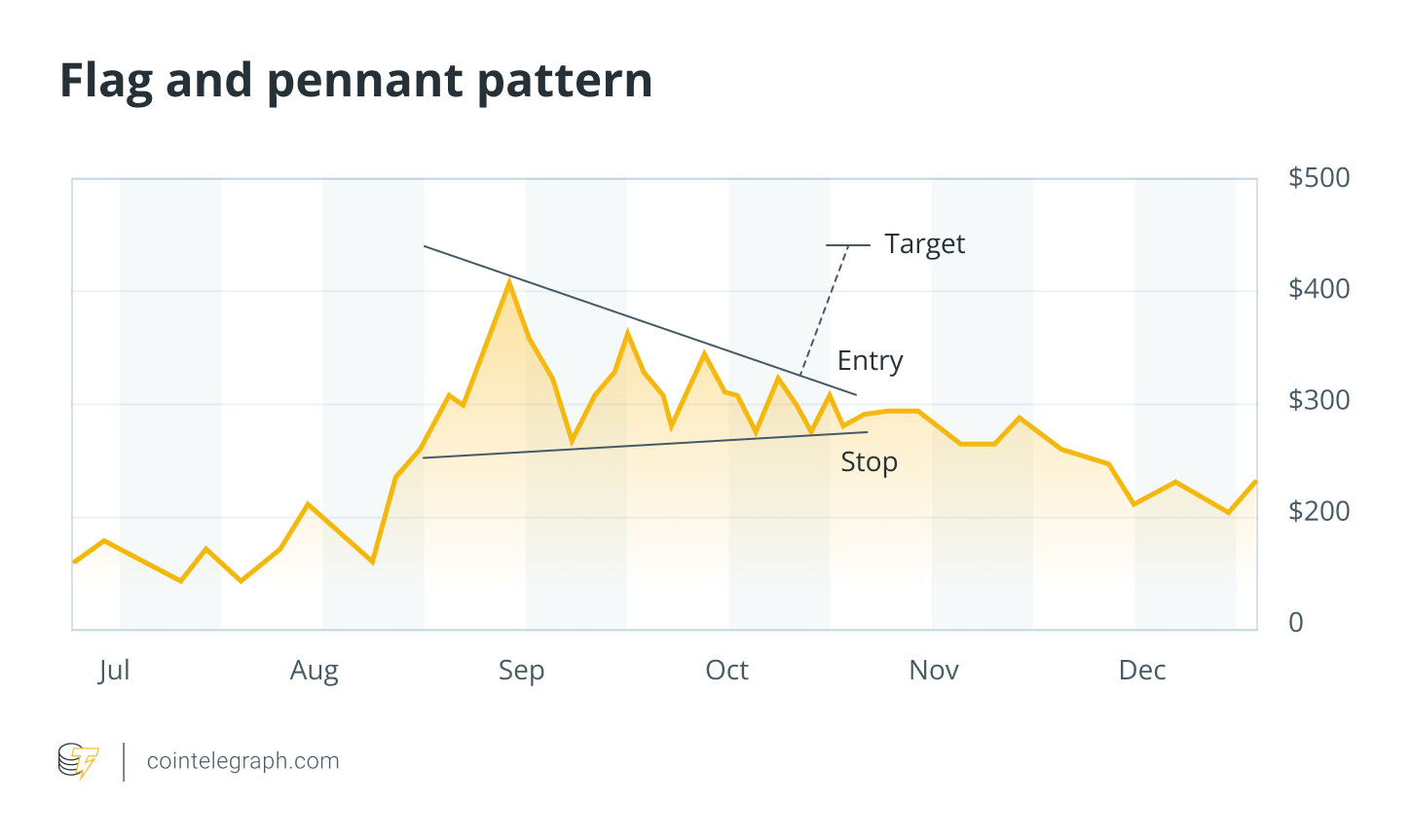
Flag and pennant patterns form after sharp price moves. Flags appear as small, parallel channels, while pennants look like compact triangles. Both signal brief pauses before the prevailing trend continues.
Flag and pennant patterns form after sharp price moves. Flags appear as small, parallel channels, while pennants look like compact triangles. Both signal brief pauses before the prevailing trend continues.
How to read: A steep “pole” followed by a short consolidation suggests that the trend is likely to resume. These patterns are bullish in uptrends and bearish in downtrends. Traders often enter on a pullback within the flag or pennant to improve risk-reward.
How to read: A steep “pole” followed by a short consolidation suggests that the trend is likely to resume. These patterns are bullish in uptrends and bearish in downtrends. Traders often enter on a pullback within the flag or pennant to improve risk-reward.
Stop-loss: Place it below the flag or pennant’s low for bullish setups, or above the high for bearish ones.
Stop-loss: Place it below the flag or pennant’s low for bullish setups, or above the high for bearish ones.
Example: During bullish market phases, tokens often display flag or pennant formations. In 2025, Solana’s (SOL) price action formed a bullish flag pattern amid rapid ecosystem growth, including new DeFi protocol launches. This setup signaled the continuation of its upward trend.
Example: During bullish market phases, tokens often display flag or pennant formations. In 2025, Solana’s (SOL) price action formed a bullish flag pattern amid rapid ecosystem growth, including new DeFi protocol launches. This setup signaled the continuation of its upward trend.
5. Wedge
5. Wedge
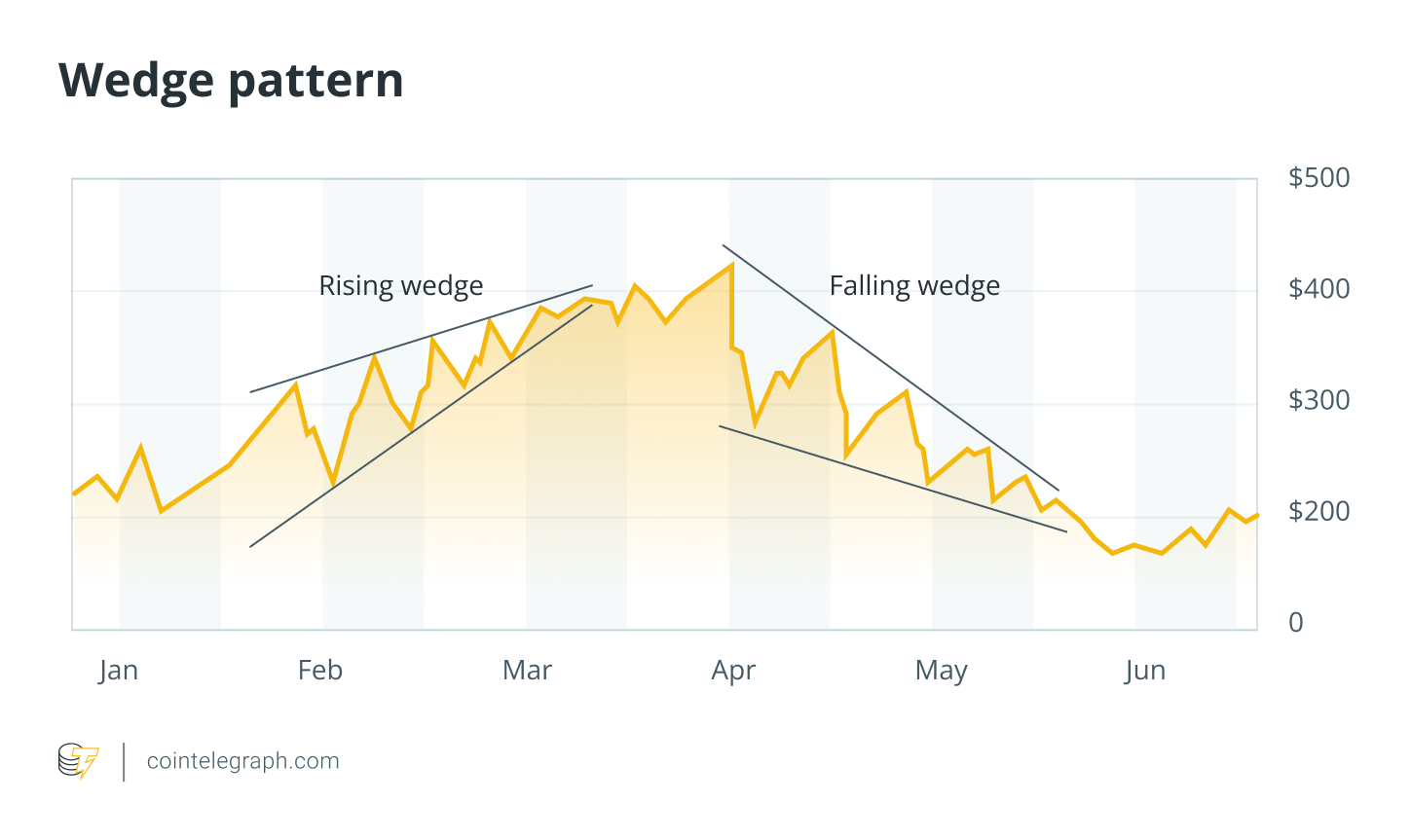
Wedge patterns form when price action creates converging trendlines that slope either upward (rising wedge, typically bearish) or downward (falling wedge, typically bullish).
Wedge patterns form when price action creates converging trendlines that slope either upward (rising wedge, typically bearish) or downward (falling wedge, typically bullish).
How to read: A rising wedge in an uptrend often signals a potential reversal as momentum weakens, while a falling wedge in a downtrend points to a possible bullish reversal. These patterns can also act as continuation signals when aligned with the prevailing trend. Measure the wedge’s height and project it from the breakout point to estimate the target move.
How to read: A rising wedge in an uptrend often signals a potential reversal as momentum weakens, while a falling wedge in a downtrend points to a possible bullish reversal. These patterns can also act as continuation signals when aligned with the prevailing trend. Measure the wedge’s height and project it from the breakout point to estimate the target move.
Stop-loss: Place it outside the wedge’s opposite trendline.
Stop-loss: Place it outside the wedge’s opposite trendline.
Example: Wedge patterns can help identify potential market tops during overheated conditions. In 2025, during a period of heightened speculation, Arbitrum’s (ARB) price action formed a rising wedge pattern, which was later followed by a market correction.
Example: Wedge patterns can help identify potential market tops during overheated conditions. In 2025, during a period of heightened speculation, Arbitrum’s (ARB) price action formed a rising wedge pattern, which was later followed by a market correction.
Did you know? Many crypto traders prefer logarithmic charts over linear ones. While linear scales display absolute price changes, log scales highlight percentage changes, making it easier to compare Bitcoin’s early rise from $1 to $10 with its later move from $10,000 to $20,000, both representing 10x growth.
Did you know? Many crypto traders prefer logarithmic charts over linear ones. While linear scales display absolute price changes, log scales highlight percentage changes, making it easier to compare Bitcoin’s early rise from $1 to $10 with its later move from $10,000 to $20,000, both representing 10x growth.
Complementary tools and indicators for trend analysis
Complementary tools and indicators for trend analysis
To strengthen your trend analysis, you can use several key indicators and tools. Important indicators include:
To strengthen your trend analysis, you can use several key indicators and tools. Important indicators include:
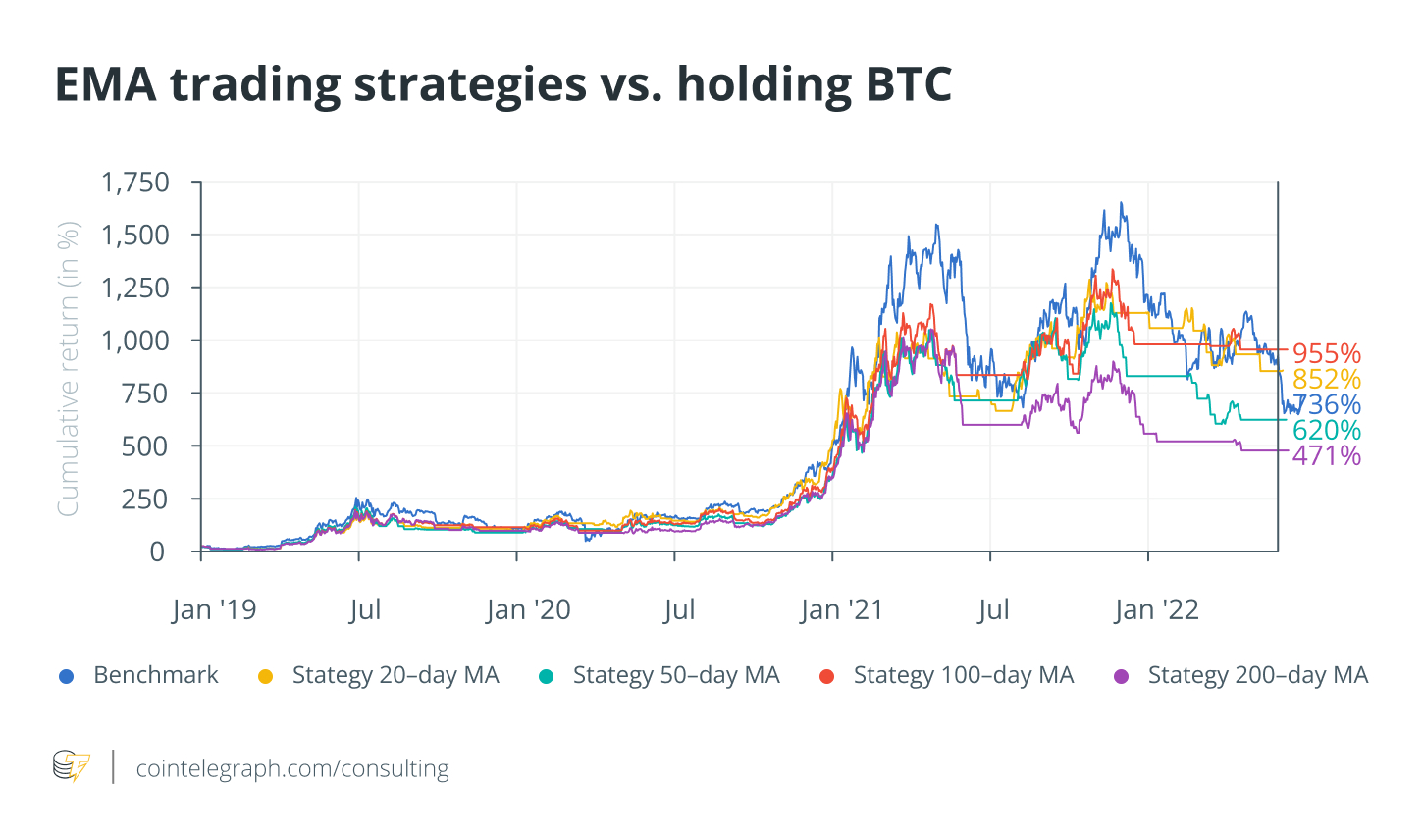
Moving averages (SMA/EMA crossovers): Track trends by watching when a short-term exponential moving average (EMA) crosses above or below a long-term simple moving average (SMA). The EMA gives more weight to recent price data, allowing it to respond faster to market changes, while the SMA calculates the average closing price over a selected period for a smoother view of the overall trend.
Moving averages (SMA/EMA crossovers): Track trends by watching when a short-term exponential moving average (EMA) crosses above or below a long-term simple moving average (SMA). The EMA gives more weight to recent price data, allowing it to respond faster to market changes, while the SMA calculates the average closing price over a selected period for a smoother view of the overall trend.
Relative Strength Index (RSI): Detects overbought (>70) or oversold (prevents traders from chasing rallies or exiting too early during corrections.
Relative Strength Index (RSI): Detects overbought (>70) or oversold (prevents traders from chasing rallies or exiting too early during corrections.
Moving average convergence/divergence (MACD): Uses a histogram to identify momentum shifts when the MACD line crosses the signal line. A widening gap between the two often indicates strengthening momentum.
Moving average convergence/divergence (MACD): Uses a histogram to identify momentum shifts when the MACD line crosses the signal line. A widening gap between the two often indicates strengthening momentum.
Bollinger Bands: Track volatility squeezes to spot potential breakouts or reversals. When the price breaks above or below the bands, it signals an upcoming move. Narrowing bands suggest consolidation, often followed by sharp price swings.
Bollinger Bands: Track volatility squeezes to spot potential breakouts or reversals. When the price breaks above or below the bands, it signals an upcoming move. Narrowing bands suggest consolidation, often followed by sharp price swings.
Volume analysis: Volume spikes confirm market participation during breakouts or reversals, validating chart patterns. Declining volume during a trend can signal weakening momentum.
Volume analysis: Volume spikes confirm market participation during breakouts or reversals, validating chart patterns. Declining volume during a trend can signal weakening momentum.
Did you know? Volume bars are more than background visuals. They confirm whether price breakouts are trustworthy. A surge in volume during a breakout signals strong market participation, while low volume may warn of a false move. Many traders view volume as the “heartbeat” of chart analysis.
Did you know? Volume bars are more than background visuals. They confirm whether price breakouts are trustworthy. A surge in volume during a breakout signals strong market participation, while low volume may warn of a false move. Many traders view volume as the “heartbeat” of chart analysis.
Risk management and best practices
Risk management and best practices
Successful crypto trading relies on strong risk management and disciplined methods. Avoid analyzing patterns in isolation: Instead, combine chart patterns with indicators (such as RSI) and relevant news to improve accuracy. Always risk only a small portion of your capital to protect against sudden market volatility.
Successful crypto trading relies on strong risk management and disciplined methods. Avoid analyzing patterns in isolation: Instead, combine chart patterns with indicators (such as RSI) and relevant news to improve accuracy. Always risk only a small portion of your capital to protect against sudden market volatility.
From a psychological standpoint, resisting fear of missing out (FOMO) is essential in 2025’s AI-driven environment, where automated trading and social media can easily inflate asset prices. Stay grounded, avoid hype and remain committed to your strategy.
From a psychological standpoint, resisting fear of missing out (FOMO) is essential in 2025’s AI-driven environment, where automated trading and social media can easily inflate asset prices. Stay grounded, avoid hype and remain committed to your strategy.
Common mistakes include falling for false breakouts without volume confirmation and overtrading on short timeframes, which can lead to mental fatigue. To strengthen your approach, consider backtesting: applying your trading strategy to historical data to evaluate its past performance and potential future profitability.
Common mistakes include falling for false breakouts without volume confirmation and overtrading on short timeframes, which can lead to mental fatigue. To strengthen your approach, consider backtesting: applying your trading strategy to historical data to evaluate its past performance and potential future profitability.
This article does not contain investment advice or recommendations. Every investment and trading move involves risk, and readers should conduct their own research when making a decision.
This article does not contain investment advice or recommendations. Every investment and trading move involves risk, and readers should conduct their own research when making a decision.
 Crypto Front News
 Coindoo
 CoinCryptoNews
 Coinlive.me
 Crypto Economy
 Coindoo.com
 Cointelegraph
 Crypto News Land
 BlockchainReporter