Here's a revised version of the article, focusing on improved readability and removing potentially unwanted content, while preserving the original format and the 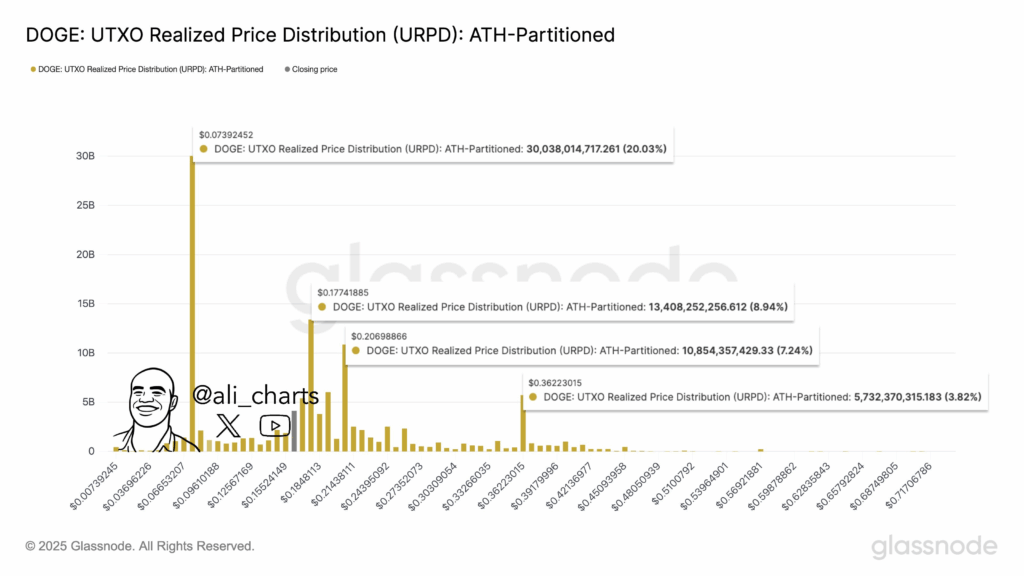
The realized price chart indicates that $0.073 holds the largest DOGE volume, with 30 billion coins transacted at that level.
DOGE encounters resistance at $0.18, where over 13 billion coins were last moved, potentially hindering further upward movement.
Analyst Ali has identified $0.18, $0.21, and $0.36 as key zones where holders might consider selling if prices continue to rise.
Dogecoin (DOGE) is currently approaching significant resistance levels at $0.18, $0.21, and $0.36, based on realized price clusters. This information was shared by analyst Ali on July 7th, derived from the UTXO Realized Price Distribution (URPD). The URPD chart illustrates the volume of DOGE last moved at specific price points, which now function as potential resistance areas.
Source: X
$0.073, $0.18, and $0.21: Key Realized Volume Zones
The most substantial concentration of Dogecoin holdings is at the $0.073 price point, totaling 30 billion DOGE, representing 20.03% of the total supply. This level likely reflects buyers who acquired the asset during previous market lows. Holders at this price may be profitable and could choose to sell during price rallies.
The next significant cluster is at $0.18, accounting for 13.4 billion DOGE or 8.94% of the realized supply. This represents the first major resistance level identified by Ali. Following that, $0.21 acts as the subsequent resistance cluster, with over 10.8 billion DOGE held at that level, or 7.24% of the supply.
The data reveals a sharp decrease in realized volume beyond the $0.21 range. Fewer coins have changed hands above this level, suggesting that potential selling pressure might lessen beyond it. However, the $0.36 range still shows a notable cluster of 5.73 billion DOGE, or 3.82% of the total supply.
Realized Price Distribution: Providing Market Insights
The URPD metric, used in this analysis, tracks the price at which coins were last moved on-chain. This data helps pinpoint areas where traders may be inclined to take profits or minimize losses. As Dogecoin approaches these high-volume clusters, these points can act as both psychological and technical resistance.
The three levels—$0.18, $0.21, and $0.36—were specifically highlighted by Ali as crucial zones to monitor. On-chain metrics like URPD are often utilized by institutional traders to gauge buyer and seller density. These price levels often coincide with historical peaks or congestion zones from past market cycles.
Ali’s chart, shared with a broad audience, cautioned viewers to "keep an eye" on these three price ranges.
Market Reaction and Trade Strategies Focused on Resistance
Many traders are incorporating this data into their entry and exit strategies, considering their proximity to these price thresholds. Community responses indicated that $0.36, as the final resistance, might serve as a peak if upward momentum weakens. Traders anticipating breakouts may view $0.18 and $0.21 as near-term pivot points.
The URPD histogram suggests that most volume is concentrated below $0.21, potentially giving Dogecoin more room to advance if it overcomes the initial barriers. Once DOGE surpasses these clusters, reduced resistance could facilitate smoother price movement. Sustained price stability above $0.21 could pave the way for a retest of $0.36.
Technical analysts often combine this data with momentum indicators to determine whether demand can overcome selling pressure. If volume increases as the price approaches these levels, traders may anticipate a continued upward trend. Without sufficient support, price reversals may occur near these high-density zones.
 Crypto Front News
 Coindoo
 CoinCryptoNews
 Coinlive.me
 Crypto Economy
 Coindoo.com
 Cointelegraph
 Crypto News Land
 BlockchainReporter