Here's a refined version of the article, focusing on clarity, flow, and removing potential extraneous elements while retaining the requested formatting and placeholder:
According to recent data visualized by the financial firm River, retail investors currently hold over two-thirds of all Bitcoin in circulation, despite growing institutional interest in the cryptocurrency.

River’s analysis, dated July 14, 2025, indicates that individual wallets control approximately 14 million BTC. This significantly surpasses the combined holdings of corporations, investment funds, and governments. These institutional entities collectively account for roughly 13.8% of the total Bitcoin supply, suggesting that mainstream financial institutions are still in the process of significantly increasing their Bitcoin allocations.
The report highlights this difference as a potential strategic disadvantage for larger institutions. Retail users had a considerable head start, accumulating Bitcoin for over 15 years before major financial players began entering the market. Now, institutions seeking to establish a significant position must navigate a market characterized by potentially limited liquidity and upward price pressure.
Adding to the perception of scarcity are substantial portions of the total Bitcoin supply that are either dormant or inaccessible. An estimated 1.6 million coins are considered permanently lost. Additionally, approximately 968,000 BTC – potentially mined by Bitcoin's pseudonymous creator, Satoshi Nakamoto – have never been transferred. With just over 1 million BTC remaining to be mined, the opportunity for large-scale accumulation is diminishing.
Government holdings remain relatively small according to River's estimates, with approximately 314,000 BTC attributed to national treasuries. While independent trackers suggest potentially larger holdings, particularly for countries like the U.S. and China, River's model utilizes a conservative definition based solely on officially recognized wallets.

As Exchange Traded Fund (ETF) inflows and corporate treasury allocations increase, pressure on the available circulating Bitcoin supply is likely to intensify. If this trend persists, the next phase of Bitcoin's development may be defined not by early adopters, but by the extent to which late entrants are willing to pay to acquire Bitcoin.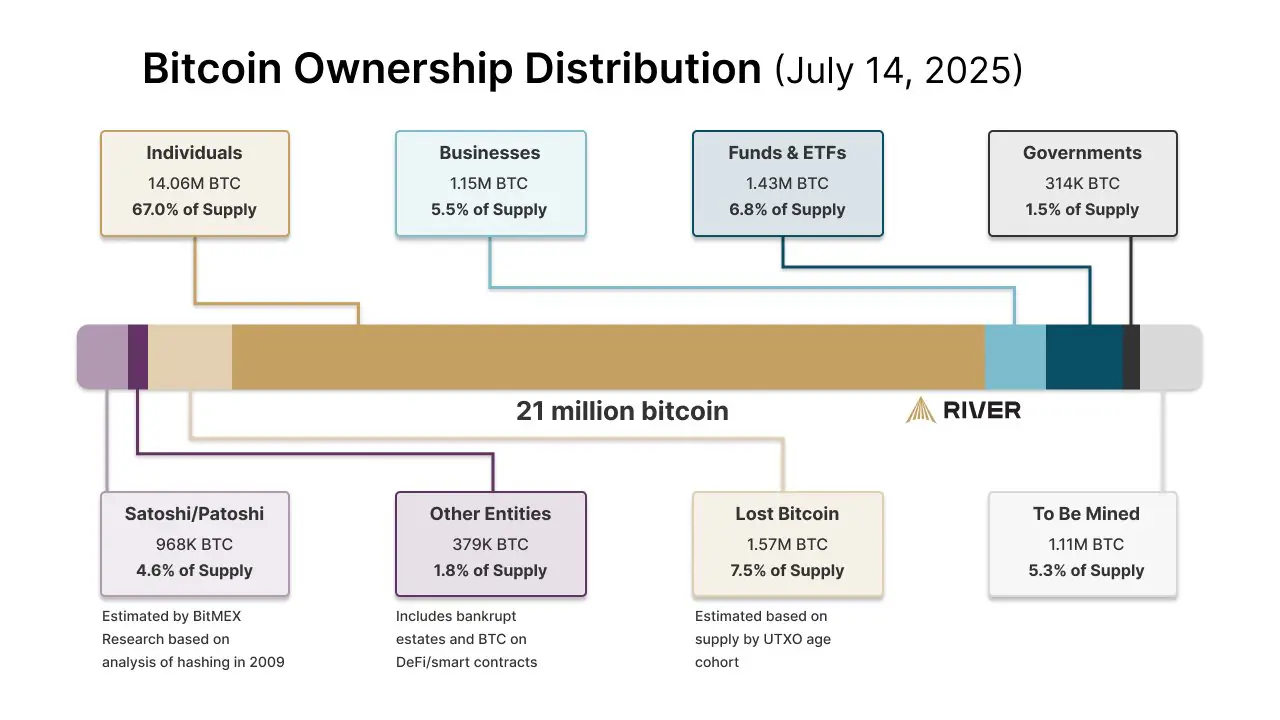
 Crypto Front News
 Coindoo
 CoinCryptoNews
 Coinlive.me
 Crypto Economy
 Coindoo.com
 Cointelegraph
 Crypto News Land
 BlockchainReporter