The US Secret Service has quietly amassed nearly $400 million in digital assets over the past decade, building one of the world's most significant crypto cold wallets, according to a Bloomberg report citing individuals familiar with the matter.
The agency’s Global Investigative Operations Center (GIOC) has diligently tracked funds using open-source tools, blockchain analysis techniques, and persistent investigation. Jamie Lam, an investigative analyst with the US Secret Service, reportedly shared these details with law enforcement officials in Bermuda last month.
The agency’s crypto holdings, much of which is secured in a single cold-storage wallet, are the result of a series of successful investigations into various scams. A common scheme involves scammers enticing victims into seemingly legitimate crypto investment platforms. These victims often experience initial profits, which are then followed by the sudden disappearance of the sites, along with their deposits.
“That’s how they do it,” Lam explained. “They’ll send you a photo of a really good-looking guy or girl. But it’s probably some old guy in Russia.”
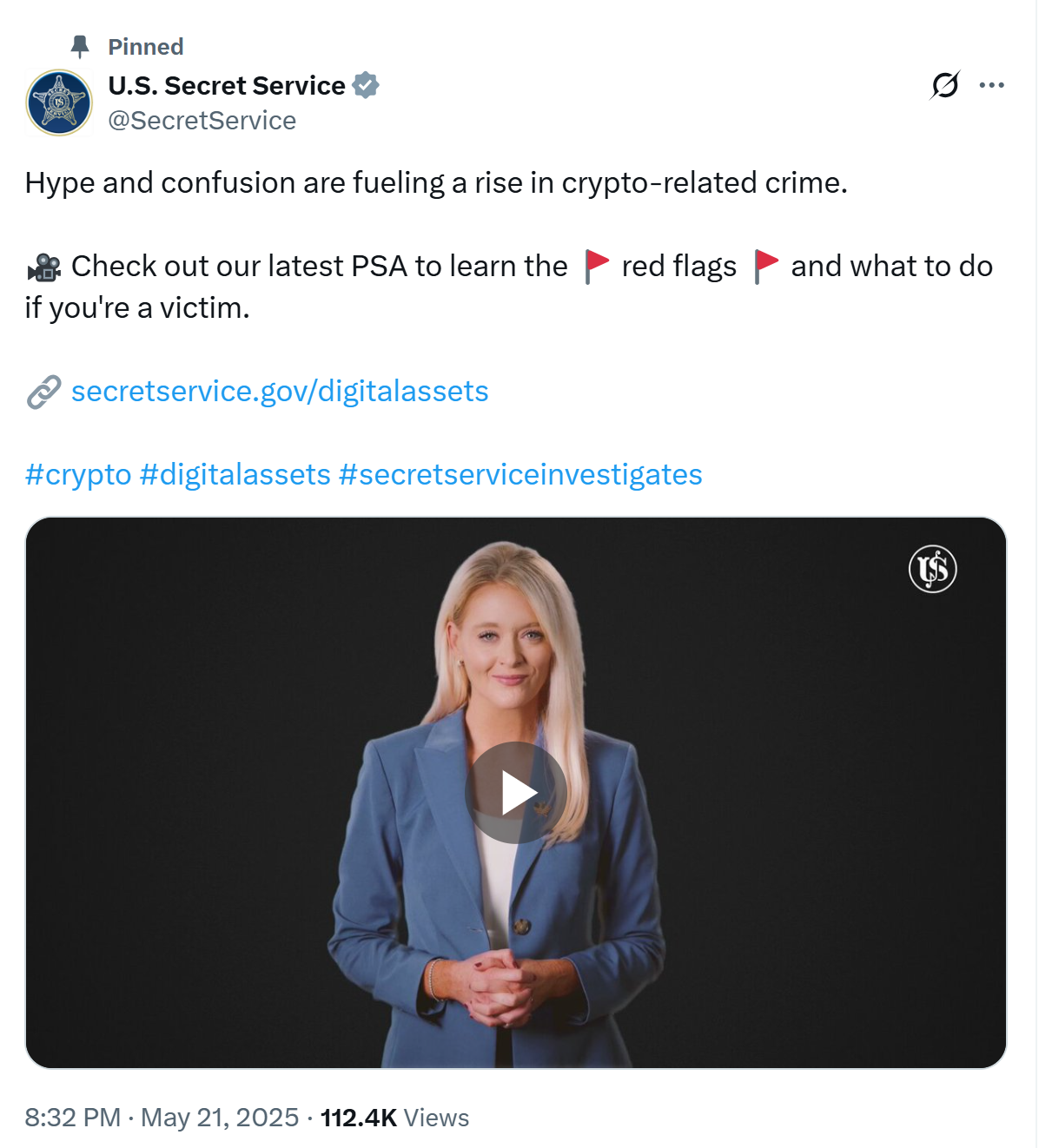
Source: US Secret Service
Related: Brazil’s central bank service provider hacked, $140M stolen
Blockchain trails unmask crypto scams
Lam’s team leverages domain records, blockchain transaction data, and even minor VPN security lapses to identify and track down fraudsters. In one instance, a cryptocurrency payment led investigators to another wallet, revealing further connections. In another case, a brief VPN failure exposed an IP address, enabling agents to piece together the intricate digital trail of the scam.
Leading the Secret Service’s crypto strategy is Kali Smith, who heads a team responsible for training officials in over 60 countries on how to identify and combat online financial crimes.
The agency has strategically focused on jurisdictions with weaker regulatory oversight or programs offering residency to foreign nationals. “Sometimes after just a week-long training, they can be like, ‘Wow, we didn’t even realize that this is occurring in our country,’” Smith noted.
The Secret Service’s efforts have uncovered a range of scams, from deceptive romance-investment schemes to sextortion cases. One investigation involved an Idaho teenager who sent a nude photo to an online stranger. The scammer extorted $300 on two occasions before the teen reported the incident to the police.
Analysts traced the payments through another coerced teenager acting as a money mule, which led to an account associated with nearly $4.1 million in transactions under a Nigerian passport. British police apprehended the suspected extortionist upon his arrival in Guildford, England, where he remains in custody awaiting extradition.
Related: ‘Small possibility’ $8.6B Bitcoin transfer was a hack
Crypto scams top losses
Crypto-related scams have emerged as the leading cause of internet crime losses in the US. Americans reported $9.3 billion stolen through crypto fraud in 2024, accounting for more than half of the total $16.6 billion in internet crime losses that year, according to FBI data.
The first half of 2025 has seen more than $2.47 billion in losses due to hacks, scams and exploits, representing a nearly 3% increase compared to the $2.4 billion stolen in 2024.
Recovering stolen crypto often hinges on cooperation from industry participants. Coinbase and Tether have publicly acknowledged their assistance in high-profile cases by analyzing transactions and freezing compromised wallets. One of the largest single recoveries involved $225 million in USDt (USDT) connected to romance scams.
 Crypto Front News
 Coindoo
 CoinCryptoNews
 Coinlive.me
 Crypto Economy
 Coindoo.com
 Cointelegraph
 Crypto News Land
 BlockchainReporter