The cryptocurrency market experienced a significant sell-off this week as the United States officially implemented its latest round of trade tariffs. This development has shaken investor confidence across both traditional and digital asset markets. Bitcoin's price dipped below the crucial $115,000 mark, while Ethereum's price edged towards the $3,600 level. The downward pressure wasn't confined to major cryptocurrencies; altcoins such as Solana, Cardano, and Dogecoin also saw declines of over 5–8%, indicating widespread market anxiety.
But what factors are truly driving this downturn, and what potential future paths might the crypto market take?
Why U.S. Tariffs Are Impacting the Crypto Market
The recently enacted U.S. tariffs, targeting key sectors like Chinese tech imports and rare earth materials, have created a ripple effect throughout the global financial system. Historically, the cryptocurrency market has shown sensitivity to macroeconomic uncertainty, and this instance is proving to be no exception.
As tariffs fuel concerns about inflation and disrupt global trade flows, investors often shift their capital into perceived safer, less volatile assets. This "risk-off" strategy results in substantial selling pressure on speculative assets, including cryptocurrencies. Within 24 hours of the tariffs taking effect, over $500 million in leveraged long positions were liquidated across major exchanges. This level of liquidation amplified the downward price momentum and contributed to the fear-driven sell-off.
Bitcoin and Ethereum Under Pressure
Bitcoin's descent below $115,000 is technically noteworthy. While the $120,000 area had acted as a psychological barrier for several weeks, the recent breakdown suggests the possibility of further downside unless a swift reversal occurs. Ethereum is also feeling the effects, trading near $3,600 with limited volume support, and attention focused on the $3,400 support level. On the other hand, the drop was supported by over $680 million in long liquidations, with Ethereum recording the highest.
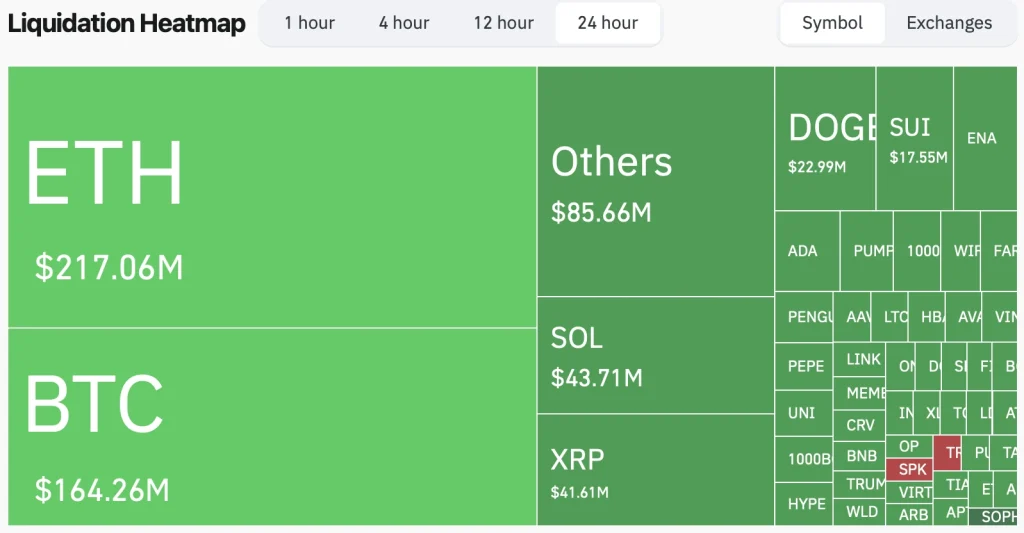
According to data from Coinglass, over 180,000 traders were liquidated, with total liquidations reaching $727.29 million. However, analysts are divided on whether this signifies the beginning of a larger correction or a healthy shakeout before the next upward movement. Historically, Bitcoin has demonstrated resilience after global market shocks, rebounding once uncertainty subsides. If inflation data stabilizes and central banks signal a more dovish stance, cryptocurrency assets could recover quickly.
Key Factors to Watch Going Forward
As markets absorb the geopolitical and economic consequences of the U.S. tariff actions, traders will be closely monitoring the following key factors:
- Can buyers defend Bitcoin's crucial support zone between $112,000 and $110,000, should the price continue to decline?
- With Ethereum's price approaching $3,600, can it maintain support at $3,400, as a break below this level could lead to steeper declines?
- The response of global central banks to any potential dovish pivot could serve as a catalyst for a robust recovery.
The recent U.S. tariffs have undeniably unsettled the cryptocurrency market, causing short-term pain. However, should inflation fears intensify and fiat currencies weaken, Bitcoin and other digital assets could experience renewed interest as potential safe-haven investments. Until then, expect heightened volatility, but opportunities may arise for those prepared to take a long-term view.
 Crypto Front News
 Coindoo
 CoinCryptoNews
 Coinlive.me
 Crypto Economy
 Coindoo.com
 Cointelegraph
 Crypto News Land
 BlockchainReporter