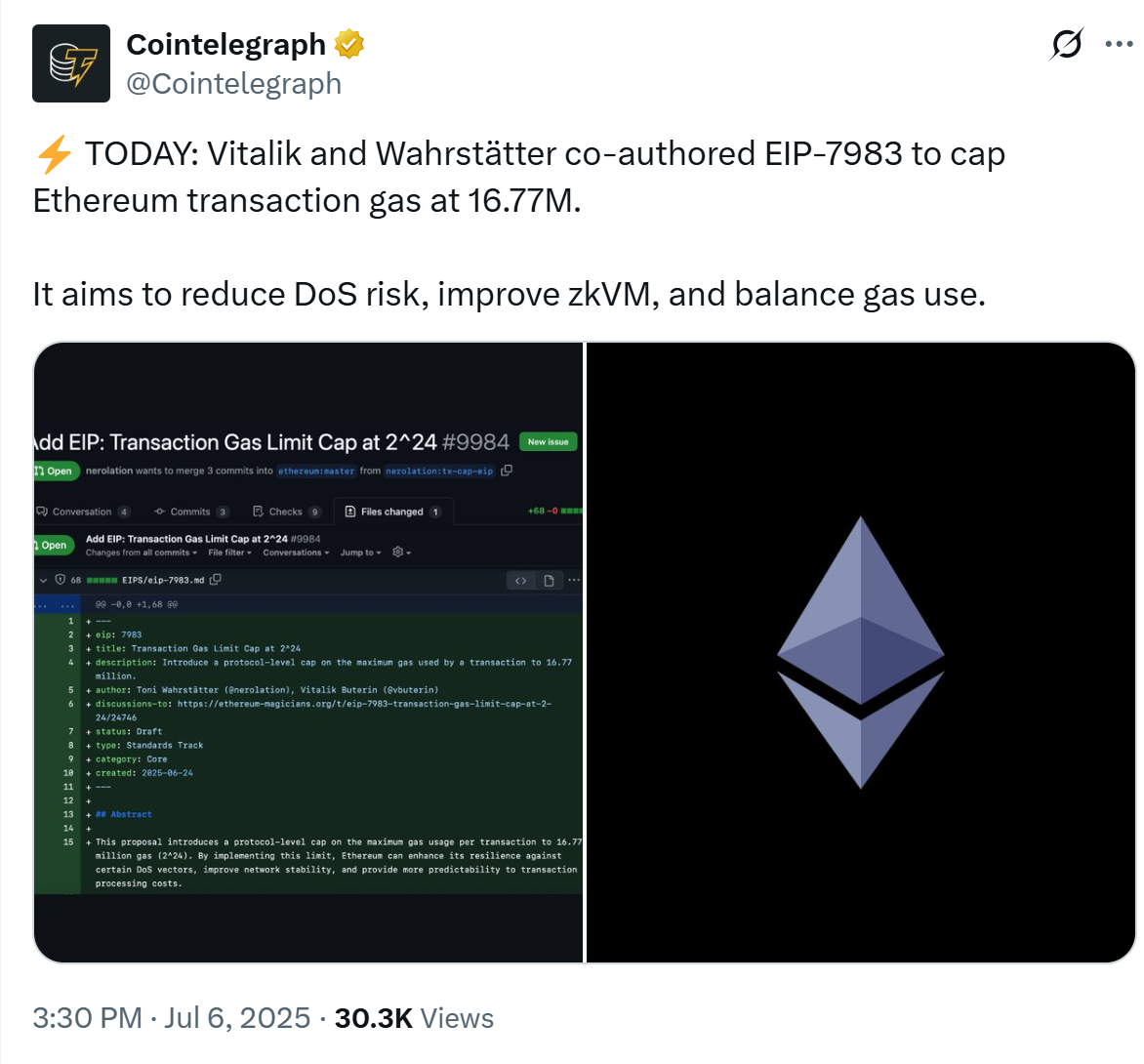
Ethereum co-founder Vitalik Buterin and researcher Toni Wahrstätter have proposed EIP-7983, an initiative designed to enhance network security and performance by introducing a protocol-level cap on transaction gas usage.
The proposal suggests a maximum gas limit of 16.77 million (2²⁴) for individual transactions. "By implementing this limit, Ethereum can bolster its resilience against specific Denial-of-Service (DoS) vectors, improve overall network stability, and offer more predictable transaction processing costs," the proposal states.
Currently, Ethereum's architecture allows a single transaction to theoretically consume the entire block's gas limit, creating a vulnerability to DoS attacks and leading to unpredictable network behavior.
EIP-7983 aims to distribute gas consumption more evenly by capping individual transactions, thus reducing the potential for single transactions to overwhelm block capacity.
Gas Cap to Enhance zkVM Compatibility
The proposed cap is also intended to improve compatibility with zero-knowledge virtual machines (zkVMs) by encouraging the division of large transactions into smaller, more manageable segments.
According to the draft, transactions specifying gas limits exceeding 16.77 million would be rejected during block validation, preventing their entry into the network or inclusion in new blocks. This cap operates independently of the overall block gas limit, which miners and validators can continue to adjust within the existing consensus rules.
Buterin and Wahrstätter selected 16.77 million as the cap to strike a balance between complexity and performance, asserting that it accommodates current advanced DeFi use cases and contract deployments without introducing undue risks.
"This value enables most current use cases, including contract deployments and advanced DeFi interactions, while ensuring consistent performance characteristics," the proposal explains.
While the proposal introduces a backward-incompatible change for transactions exceeding the new limit, the authors highlight that the majority of existing transactions fall significantly below the cap, minimizing the impact on both users and developers.
EIP-7983 builds upon previous efforts, such as EIP-7825, to enhance predictability in transaction execution.
Vitalik's Vision for a Simpler Ethereum
In May, Buterin advocated for simplifying the Ethereum network's base protocol to enhance efficiency, security, and accessibility, drawing inspiration from Bitcoin's minimalist design.
He proposed restructuring Ethereum's architecture across consensus, execution, and shared components to achieve a more streamlined design within five years. Buterin argued that Ethereum's increasing complexity has resulted in longer development times, higher costs, and elevated security risks.
More recently, the Ethereum innovator introduced a novel digital identity system called "pluralistic identity," suggesting it could protect privacy while enabling fair participation in digital interactions.
 Crypto Front News
 Coindoo
 CoinCryptoNews
 Coinlive.me
 Crypto Economy
 Coindoo.com
 Cointelegraph
 Crypto News Land
 BlockchainReporter