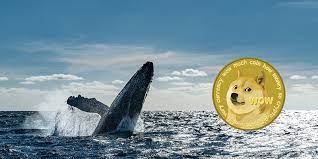
Dogecoin's recent troubles can be summed up in three words: whales, sell-off, and plunge. Large holders have been offloading their DOGE, leading to a significant drop in market cap. Let's dive into what's happening and what it might mean for the future of this meme cryptocurrency.
Les récents problèmes de Dogecoin peuvent être résumés en trois mots : baleines, liquidation et chute. Les grands détenteurs se sont débarrassés de leur DOGE, entraînant une baisse significative de la capitalisation boursière. Examinons ce qui se passe et ce que cela pourrait signifier pour l'avenir de cette crypto-monnaie mème.
Whale Watch: Who's Selling and Why?
Whale Watch : qui vend et pourquoi ?
Data from Santiment reveals that wallets holding between 10 million and 100 million DOGE have been actively selling since mid-October, offloading approximately one billion coins. These 'whales' are often early investors who profited handsomely and are now taking gains. Analyst Ali Martinez highlighted these outflows, suggesting a planned profit-taking strategy rather than panic selling.
Les données de Santiment révèlent que les portefeuilles contenant entre 10 et 100 millions de DOGE se vendent activement depuis la mi-octobre, déchargeant environ un milliard de pièces. Ces « baleines » sont souvent les premiers investisseurs qui ont largement profité et qui réalisent désormais des gains. L'analyste Ali Martinez a souligné ces sorties de capitaux, suggérant une stratégie planifiée de prise de bénéfices plutôt qu'une vente panique.
The Plunge: A $30 Billion Market Cap Wipeout
Le plongeon : un effacement de la capitalisation boursière de 30 milliards de dollars
This selling pressure has had a dramatic impact. Dogecoin's market capitalization plummeted from $55.7 billion on October 28 to $25.1 billion on November 4. The price dipped below $0.18, triggering algorithmic trading systems to execute predetermined exit strategies, further fueling the decline. One trader reportedly made over $36 million shorting DOGE and Ethereum during this period.
Cette pression vendeuse a eu un impact dramatique. La capitalisation boursière de Dogecoin a chuté de 55,7 milliards de dollars le 28 octobre à 25,1 milliards de dollars le 4 novembre. Le prix est tombé en dessous de 0,18 $, déclenchant les systèmes de trading algorithmiques pour exécuter des stratégies de sortie prédéterminées, alimentant encore davantage la baisse. Un commerçant aurait gagné plus de 36 millions de dollars en vendant à découvert DOGE et Ethereum au cours de cette période.
Technical Breakdown and Cascade Effect
Panne technique et effet cascade
The breach of the $0.18 support level acted as a technical glitch, causing automatic selling across major exchanges. This triggered a cascade effect, leading to the liquidation of over $1.36 billion in cryptocurrency derivatives in a single day. Dogecoin was disproportionately affected by these forced closures.
La rupture du niveau de support de 0,18 $ a agi comme un problème technique, provoquant une vente automatique sur les principales bourses. Cela a déclenché un effet en cascade, conduisant à la liquidation de plus de 1,36 milliard de dollars de dérivés de crypto-monnaie en une seule journée. Dogecoin a été touché de manière disproportionnée par ces fermetures forcées.
Divergent Sentiments: Whales vs. Retail
Sentiments divergents : baleines contre commerce de détail
Despite the price drop, trading volume surged by 90%, indicating divergent market sentiment. While whales were selling, smaller traders viewed the dip as a buying opportunity. This suggests a difference in investment strategies, with early accumulators taking profits and retail participants attempting to capitalize on short-term volatility.
Malgré la baisse des prix, le volume des transactions a bondi de 90 %, indiquant un sentiment divergent du marché. Alors que les baleines se vendaient, les petits commerçants considéraient la baisse comme une opportunité d'achat. Cela suggère une différence dans les stratégies d'investissement, les premiers accumulateurs prenant leurs bénéfices et les participants de détail tentant de capitaliser sur la volatilité à court terme.
Beyond the Hype: A Shift Towards Utility?
Au-delà du battage médiatique : un virage vers l’utilitaire ?
While Dogecoin navigates these choppy waters, there's a broader trend in the crypto market towards tokens offering tangible services. Projects like Bittensor and Remittix, focusing on AI and PayFi respectively, are gaining traction. This shift suggests that investors are increasingly seeking value beyond hype, favoring projects with real-world applications.
Alors que Dogecoin navigue dans ces eaux agitées, il existe une tendance plus large sur le marché de la cryptographie vers des jetons offrant des services tangibles. Des projets comme Bittensor et Remittix, axés respectivement sur l'IA et PayFi, gagnent du terrain. Ce changement suggère que les investisseurs recherchent de plus en plus de valeur au-delà du battage médiatique, privilégiant les projets ayant des applications concrètes.
My Take: Is This the End for Dogecoin?
Mon avis : est-ce la fin pour Dogecoin ?
Probably not, but it's a wake-up call. Dogecoin's strength has always been its community and meme appeal. However, in a maturing market, that might not be enough. While I still think Dogecoin has a place in the crypto landscape, it needs to evolve beyond being just a meme. Maybe some clever integrations or partnerships could inject new life into the project. As the saying goes, "The Doge must learn new tricks."
Probablement pas, mais c'est un signal d'alarme. La force de Dogecoin a toujours été son attrait pour la communauté et les mèmes. Toutefois, dans un marché en pleine maturité, cela pourrait ne pas suffire. Même si je pense toujours que Dogecoin a sa place dans le paysage cryptographique, il doit évoluer au-delà du simple mème. Peut-être que des intégrations ou des partenariats intelligents pourraient donner une nouvelle vie au projet. Comme le dit le proverbe : « Le Doge doit apprendre de nouveaux tours ».
Looking Ahead: Navigating the Crypto Seas
Regard vers l’avenir : naviguer dans les mers cryptographiques
The cryptocurrency market is facing numerous headwinds, including rising interest rates, regulatory uncertainty, and macroeconomic fears. Meme coins, like Dogecoin, are particularly vulnerable to these sentiment shifts due to their speculative nature. So, buckle up, crypto enthusiasts! It's going to be an interesting ride. Who knows, maybe Dogecoin will surprise us all yet!
Le marché des cryptomonnaies est confronté à de nombreux vents contraires, notamment la hausse des taux d’intérêt, l’incertitude réglementaire et les craintes macroéconomiques. Les pièces mèmes, comme Dogecoin, sont particulièrement vulnérables à ces changements de sentiment en raison de leur nature spéculative. Alors, attachez votre ceinture, passionnés de crypto ! Cela va être une balade intéressante. Qui sait, peut-être que Dogecoin nous surprendra tous encore !
 Crypto News Land
 36crypto
 Cointribune EN
 Coingabbar
 IT Times
 Coinpaper.com
 Coingabbar
 DT News
 ETHNews