-
Price: $0.05506 0.0571%
-
Market Cap: 8.64B 0.4153%
-
Volume (24h): 390.6M 0%
-
Dominance: 0.4153% 0.4153%
-
Price: $0.05506 0.0571%

How AI Actually Works (It's Just Guessing the Next Word)
Release: 2026/11/01 22:00 Reading: 0
Original author:Stack Zero
Original source:https://www.youtube.com/embed/oT6WzDMksgI
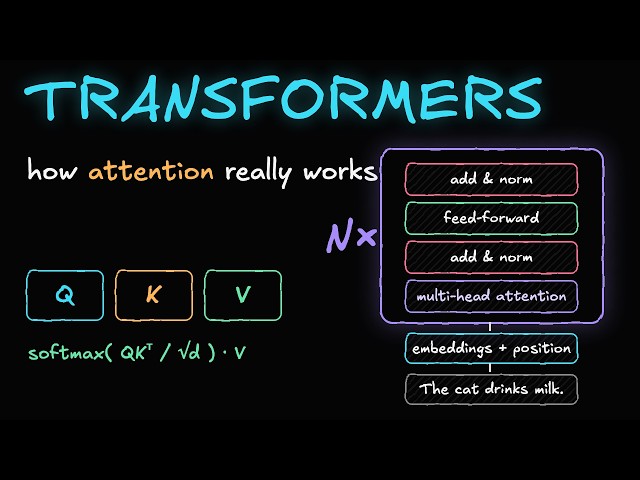
How does AI actually work? Every answer from a chatbot like ChatGPT, Claude or Gemini is written one token at a time, by a large language model guessing the next word. This visual explainer follows one prompt through the whole machine. It starts in 1948, when Claude Shannon built a sentence by flipping through a book and guessing word after word. It almost worked, then fell apart. Today the goal is the same, but the machine can look back at everything it has read. We follow "The first person to walk on the Moon was…" from tokens to vectors, through attention and 96 layers, to a list of probabilities and the one word that gets picked. Then we look at training, why models sound confident when they're wrong, and how far prediction can go. In this video: • What a large language model (LLM) is, and what "parameters" are • Tokens: how text is cut into pieces and turned into numbers • Vectors and word embeddings (Bengio, 2003) • Attention: queries, keys and values, explained visually (Vaswani et al., 2017) • Softmax, probabilities and temperature: how the next token is chosen • Training, fine-tuning and human feedback • Why AI hallucinates, context windows and knowledge cutoffs CHAPTERS How next-word prediction models actually generate text. See the logic behind probabilistic language models and attention. Most people assume AI models think like humans, but they are actually statistical engines. This film breaks down the mechanics of how next-word prediction models calculate the probability of the next token based on training data. We explore the original experiments by Claude Shannon and how they evolved into the architecture powering modern systems. Beyond simple probability, we examine word vectors and attention mechanisms to show how machines process context. You will learn why these systems sometimes produce nonsensical outputs and how they map language into mathematical space. Understanding these core principles is essential for anyone building with or researching large language models. Stack Zero. Complex Systems. Clear Explanations. Real Impact. Subscribe for weekly breakdowns of the technology behind modern software. 0:00 A 1948 experiment in guessing words 0:40 Today's chatbots: still guessing the next word 1:41 What a large language model is 2:02 Tokens and the prediction loop 2:41 Why Shannon's sentence fell apart 2:56 Shannon's human guessing game (1951) 3:32 Counting words: n-grams 3:57 Word vectors (2003) 4:19 Attention arrives (2014) 4:41 Transformers: "Attention Is All You Need" (2017) 5:07 Inside the model: one prompt, step by step 5:15 Step 1: Tokens 5:38 Step 2: Vectors 6:01 Step 3: Attention (query, key, value) 6:49 Attention heads 7:04 96 layers and feed-forward networks 7:33 Step 4: Probabilities and softmax 7:48 Step 5: Choosing the next token (greedy, sampling, temperature) 8:14 The loop: one token at a time 8:33 Training: Shannon's game at scale 9:16 From predictor to assistant 9:34 One loop, many products 9:45 Why AI hallucinates 10:18 Context windows, cutoffs and sources 10:37 Recap: the whole machine 10:59 How far can prediction go? Numbers on screen are illustrative unless a source is shown. SOURCES • Shannon (1948), A Mathematical Theory of Communication: https://people.csail.mit.edu/dmoshkov/courses/codes/shannon1948.pdf • Shannon (1951), Prediction and Entropy of Printed English: https://sites.socsci.uci.edu/~rfutrell/teaching/itl-davis/readings/shannon1951prediction.pdf • Bengio et al. (2003), A Neural Probabilistic Language Model: https://www.jmlr.org/papers/v3/bengio03a.html • Bahdanau, Cho & Bengio (2014), Neural Machine Translation by Jointly Learning to Align and Translate: https://arxiv.org/abs/1409.0473 • Vaswani et al. (2017), Attention Is All You Need: https://arxiv.org/abs/1706.03762 • Brown et al. (2020), Language Models are Few-Shot Learners (GPT-3): https://arxiv.org/abs/2005.14165 • Meta (2024), Introducing Meta Llama 3: https://ai.meta.com/blog/meta-llama-3/ • OpenAI Help, What are tokens and how to count them: https://help.openai.com/en/articles/4936856 • Geva et al. (2021), Transformer Feed-Forward Layers Are Key-Value Memories: https://arxiv.org/abs/2012.14913 • Ouyang et al. (2022), Training language models to follow instructions with human feedback: https://arxiv.org/abs/2203.02155 • OpenAI (2025), Why language models hallucinate: https://openai.com/index/why-language-models-hallucinate/ • Olsson et al. (2022), In-context Learning and Induction Heads: https://transformer-circuits.pub/2022/in-context-learning-and-induction-heads/index.html Stack Zero explains the systems behind everyday technology, from the ground up. #AI #LLM #HowAIWorks
Recent news
MORE>>-
 kumis patiler
2026-11-23 06:22
-
 Ha Ms
2026-11-23 06:22
-
 CRYPTO_BEN
2026-11-23 06:22
-
 子敬.轮回珠宝
2026-11-23 06:22
-
 CryptoMetric
2026-11-23 06:22
-
 劇翻天 Drama Go
2026-11-22 16:36
-
 CryptoMason
2026-11-22 16:22
-
 Lý Tử Ly
2026-11-22 14:42
-
 Pidoku
2026-11-22 14:15
Selected Topics
-

- Dogecoin whale activity
- Get the latest insights into Dogecoin whale activities with our comprehensive analysis. Discover trends, patterns, and the impact of these whales on the Dogecoin market. Stay informed with our expert analysis and stay ahead in your cryptocurrency journey.
-

- Dogecoin Mining
- Dogecoin mining is the process of adding new blocks of transactions to the Dogecoin blockchain. Miners are rewarded with new Dogecoin for their work. This topic provides articles related to Dogecoin mining, including how to mine Dogecoin, the best mining hardware and software, and the profitability of Dogecoin mining.
-

- Spacex Starship Launch
- This topic provides articles related to SpaceX Starship launches, including launch dates, mission details, and launch status. Stay up to date on the latest SpaceX Starship launches with this informative and comprehensive resource.
-

- King of Memes: Dogecoin
- This topic provides articles related to the most popular memes, including "The King of Memes: Dogecoin." Memecoin has become a dominant player in the crypto space. These digital assets are popular for a variety of reasons. They drive the most innovative aspects of blockchain.
Selected Articles
More>>- 1 Arctic Pablo Coin (APC): Uncovering Earth's Mysteries, One Presale at a Time
- 2 New Highs For Dogecoin, Pepe and Shiba Inu In 2025 But This Crypto May Steal The Show With 10,000% Gains
- 3 Meme Coin Doge Uprising (DUP) Could 100x After President Donald Trump Announces Crypto Strategic Reserve
- 4 Dogecoin (DOGE) Price Prediction: Could Meme Coin Hit $10 by the End of 2025?
- 5 Cardano's Charles Hoskinson Has Made Some Notable Remarks About Bitcoin and Dogecoin
- 6 Cloud Mining Craze: Bitcoin, Dogecoin, and the Quest for Passive Crypto Income
- 7 Grayscale, Dogecoin, and the ETF Debut: A New Era for Meme Coins?
- 8 Rexas Finance (RXS) Could Surge 10x by 2025, Outpacing Pepe (PEPE)
- 9 Bitcoin Trader Who Made $30 Million On DOGE Predicts 6,000% Surge For This $0.0000002 AI Token – Get 80% Bonus Tokens
- 10 Dogecoin (DOGE) Price Prediction: Meme Coin Could Rally To $0.27 As It Closes Above Pre-Halving Highs
Select Currency

US Dollar
USD

Chinese Yuan
CNY

Japanese Yen
JPY

South Korean Won
KRW

New Taiwan Dollar
TWD

Canadian Dollar
CAD

Euro
EUR

Pound Sterling
GBP

Danish Krone
DKK

Hong Kong Dollar
HKD

Australian Dollar
AUD

Brazilian Real
BRL

Swiss Franc
CHF

Chilean Peso
CLP

Czech Koruna KČ
CZK

Singapore Dollar
SGD

Indian Rupee
INR

Saudi Riyal
SAR

Vietnamese Dong
VND

Thai Baht
THB
Select Currency
-
US Dollar
USD-$

-
Chinese Yuan
CNY-¥
-
Japanese Yen
JPY-¥
-
South Korean Won
KRW -₩
-
New Taiwan Dollar
TWD-NT$
-
Canadian Dollar
CAD-$
-
Euro
EUR - €
-
Pound Sterling
GBP-£
-
Danish Krone
DKK-KR
-
Hong Kong Dollar
HKD- $
-
Australian Dollar
AUD-$
-
Brazilian Real
BRL -R$
-
Swiss Franc
CHF -FR
-
Chilean Peso
CLP-$
-
Czech Koruna KČ
CZK -KČ
-
Singapore Dollar
SGD-S$
-
Indian Rupee
INR -₹
-
Saudi Riyal
SAR -SAR
-
Vietnamese Dong
VND-₫
-
Thai Baht
THB -฿